The two terms get used as if they were interchangeable — by vendors, by procurement checklists, sometimes by lawyers. They aren’t. “Electronic signature” is a legal category: it’s defined by what it accomplishes, which is capturing a person’s intent to sign. “Digital signature” is an engineering term: it’s defined by how it works, which is public-key cryptography.
The confusion isn’t harmless. Teams that conflate the two either over-buy — paying for certificate infrastructure their contracts never needed — or under-protect, assuming a pasted image of a squiggle carries evidence it doesn’t. This article draws the line precisely, looks at what the law and the market actually say, and ends with a practical rule for choosing.
Electronic signature: a legal category
In the United States, the ESIGN Act (2000) and UETA define an electronic signature as “an electronic sound, symbol, or process attached to or logically associated with a record and executed or adopted by a person with the intent to sign.” The breadth is deliberate. A typed name, a drawn signature, a click on “I agree,” a scanned image of an ink signature — all of these qualify, because the law cares about intent and association with the record, not about the pixels.
What makes an electronic signature hold up later is not how it looks but the evidence around it: who the signer was, that they meant to sign, that the signature is tied to this document, and that the document hasn’t changed since. That is why serious e-signature platforms compete on audit trails and identity verification rather than on prettier squiggles.
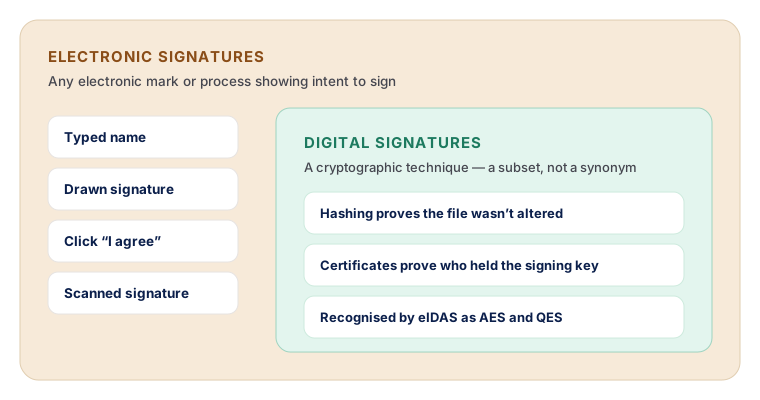
Digital signature: a cryptographic technique
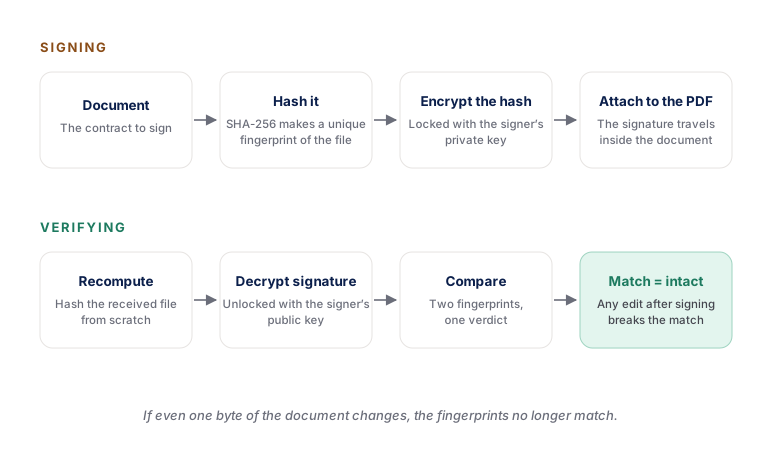
A digital signature is a specific mathematical construction. The document is run through a hash function such as SHA-256, producing a short fingerprint that is unique to that exact sequence of bytes. The fingerprint is then encrypted with the signer’s private key and attached to the document. Anyone can later verify it: decrypt the signature with the signer’s public key, recompute the fingerprint from the document in hand, and compare. If they match, the document is byte-for-byte unchanged and the signature was produced by whoever held the private key.
Identity comes from certificates: a certificate authority vouches that a given public key belongs to a given person or organisation, which is why certificate-based signing shows up as a verified panel in PDF readers.
Notice what a digital signature is not: it is not, by itself, a legal signature. It’s math. It only becomes a signature when it is embedded in a process that demonstrates a person’s intent to sign — at which point it is an electronic signature that happens to use cryptography as its evidence. Every certificate-based signing flow is an electronic signature; most electronic signatures are not digital signatures.
Side by side
| Electronic signature | Digital signature | |
|---|---|---|
| What it is | A legal category — any electronic act of intent | A cryptographic technique using key pairs |
| Defined by | Law: ESIGN, UETA, eIDAS | Mathematics: hash functions and PKI |
| Proves | Intent to sign and association with the record | Document integrity and possession of a key |
| Looks like | Typed, drawn, clicked, scanned | Invisible — a certificate panel in the PDF reader |
| Depends on | Evidence: audit trails, identity checks | Certificates issued by a certificate authority |
| Relationship | The umbrella | One way to implement the umbrella |
What ESIGN and eIDAS actually say
US law is technology-neutral. ESIGN and UETA make electronic signatures enforceable without prescribing any particular technique — courts ask for evidence of identity, intent, and integrity, however produced. (A handful of document types, such as wills and certain notices, are carved out.)
The EU’s eIDAS regulation takes a tiered approach instead. A Simple Electronic Signature (SES) is the broad category. An Advanced Electronic Signature (AES) must be uniquely linked to the signer, capable of identifying them, and able to reveal any later change to the document. A Qualified Electronic Signature (QES) is an AES created with a qualified device and a certificate from an audited trust provider — and it is the legal equivalent of a handwritten signature across the EU.
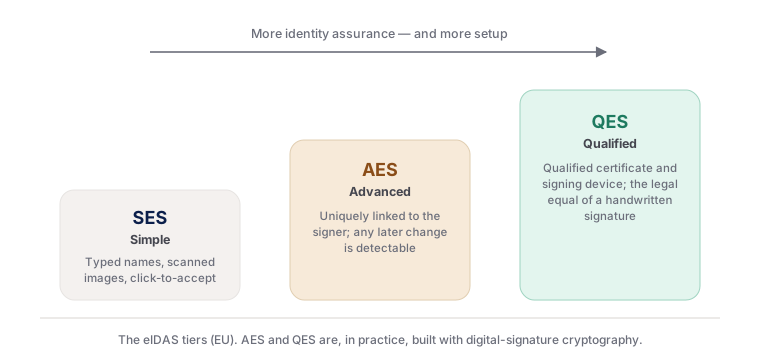
This is where the two terms meet. Regulations describe outcomes — unique linkage to the signer, detectability of tampering. Digital-signature cryptography is the standard way to deliver those outcomes at the upper tiers. The law names the destination; the math is the usual vehicle.
What the market says
Industry analysts split the space along exactly this line, which is itself a useful confirmation that the distinction is real. Mordor Intelligence sizes the e-signature platform market — the workflow tools — at roughly $7 billion in 2025, heading toward $24.5 billion by 2030 at about a 28% compound annual growth rate. MarketsandMarkets tracks the digital signature market — the certificate-and-PKI side — from $13.4 billion in 2025 toward a projected $70 billion by 2030, at a faster ~39% rate.
Two readings matter. First, both halves are growing quickly, driven by remote work, paperless operations, and compliance pressure. Second, the faster growth on the certificate side largely reflects regulated industries and eIDAS-style assurance requirements — not a signal that every NDA suddenly needs a qualified certificate. The overwhelming majority of routine business agreements are still completed with standard electronic signatures backed by good evidence.
Which one do you need?
- Routine business documents — sales agreements, NDAs, HR onboarding, internal approvals: a standard electronic signature with a strong audit trail is what courts have upheld for over two decades. This covers most of what most teams send.
- Regulated or cross-border EU scenarios where a law or counterparty names AES or QES — some financial products, notarial acts, certain government filings: you need certificate-based digital signatures from a qualified trust provider.
- When in doubt, reason from the dispute backwards: what evidence of identity, intent, and integrity would you want to show? Then check that your workflow actually produces it.
Where GingerDocs sits
GingerDocs is an electronic-signature platform built around the evidence question. Every document carries an append-only audit log in which each event — sent, viewed, signed, with IP address and timestamp — is chained to the previous one with SHA-256 hashes, so the history itself is tamper-evident. Recipients opening a document on a new device first verify with a 6-digit code sent to their email, tying the signature to the invited mailbox. And when a document completes, a Certificate of Completion is appended with a permanent reference number and a 16-character verification code derived from the audit trail, so any copy can later be checked against the record.
GingerDocs does not issue eIDAS qualified certificates — if a regulation names QES, you need a qualified trust provider for that document. For the everyday contracts most teams send, the same integrity ideas that power digital signatures — hashing and tamper-evidence, applied at the audit-trail level — deliver the evidence that actually decides disputes. The details are on our security page.